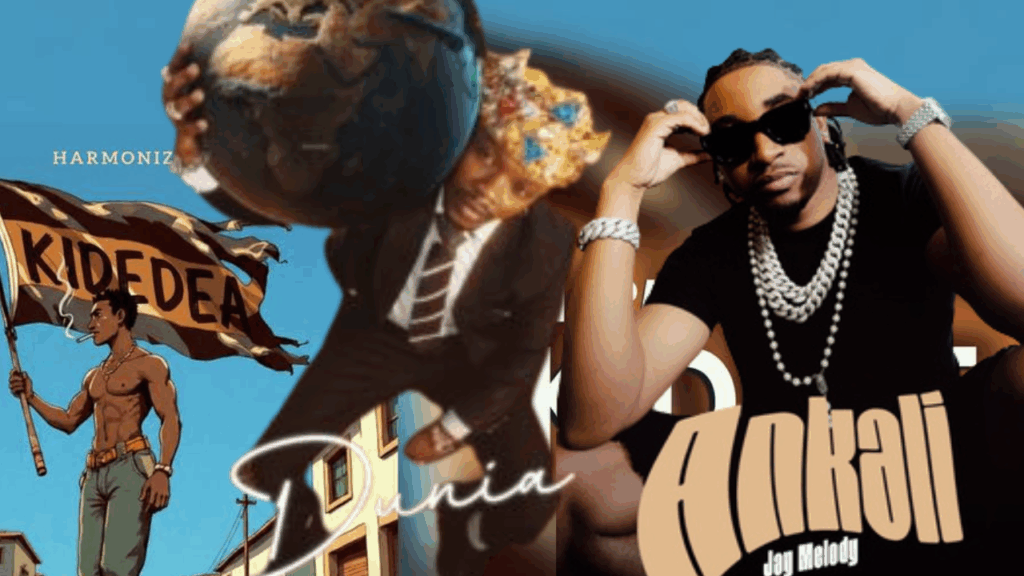
Tanzania’s vibrant music scene is buzzing again, and this time, it’s not just about Bongo Flava or Singeli. Three recent hits: Dunia by Marioo, Ankali by Jay Melody, and Kidedea by Harmonize have sparked a conversation across East Africa: Is a new Tanzanian sound emerging?
Released between August and September 2025, these tracks share an infectious, fast-paced rhythm that feels rooted in Singeli’s pulse but polished with global flair. Their energy is unmistakable, and yet, their sound doesn’t fit neatly into any single category — not quite Singeli, not purely Afrobeats, and certainly not traditional Bongo Flava.
A Brief Evolution of Tanzanian Sound
This blending of styles isn’t new to Tanzania. The country’s music history is defined by fusion, every dominant genre has evolved by borrowing, adapting, and localizing.
Bongo Flava, which took shape in the 1990s, was born from the marriage of hip-hop and pop, infused with Tanzanian storytelling and Swahili lyricism. Its moderate tempo and heartfelt themes: love, politics, and daily struggles — made it the nation’s signature sound.
Before that came Taarab, a coastal gem blending Arabic and Indian influences. Taarab is known for its poetic metaphors and slow, melodic rhythm. Then there was Mchiriku, an urban street sound built on repetitive beats and simple instruments.
Fast-forward to today, and Singeli reigns as the sound of the streets — hyper-fast, repetitive beats, raw, and direct, capturing the chaos and charisma of urban Tanzania.
The New Wave: A Sonic Crossbreed
The rise of Dunia, Ankali, and Kidedea suggests something fresh is stirring. These songs are fast, energetic, and undeniably Tanzanian — yet they carry hints of Nigerian Afrobeats and even echoes of the high-tempo Moto by Diamond Platnumz and Wawa Salegy (2019).
Are we witnessing the birth of a new genre, or just another phase in Bongo Flava’s endless evolution?
Analysts Weigh In
Music analyst Marc Ngotonie believes this new rhythm represents a transformation within Bongo Flava rather than a complete departure.
“These songs — Ankali, Dunia, and Kidedea — mark the emergence of a refined rhythm within Bongo Flava,” says Ngotonie. “It sounds like Singeli, but with a new face. There’s influence from Rema’s album Heis, but it’s also deeply Tanzanian.”
Ngotonie, who also produces the Kijiwe Nongwa podcast, describes the trend as a creative blend of international influence and local authenticity.
“The beats are smoother and more polished than traditional Singeli,” he adds. “That refinement makes them more accessible to global audiences.”
Music critic Gerry Babuu, however, sees stronger ties to West African sounds.
“This is a new version of Afrobeats entering the Tanzanian space,” Babuu argues. “It’s not purely Tanzanian. You can hear Rema’s fingerprint all over it.”
He breaks down the differences:
“Harmonize’s Kidedea fuses Afropop and Singeli — it’s not fully either. Jay Melody’s Ankali leans more toward Afropop, similar to what Rema does.”
For Babuu, what defines a song’s identity isn’t its lyrics, but its rhythm.
“The rhythm determines the genre — not the words,” he stresses.
The Verdict: Evolution, Not Revolution
Despite their contrasting perspectives, both analysts agree on one thing: Tanzania isn’t birthing a completely new genre, it’s refining its sound.
These songs represent a fusion — Singeli’s speed, Afrobeats’ polish, and the soul of Tanzanian songwriting. The result? A balanced, global-ready rhythm that keeps Bongo Flava alive while pushing its boundaries.
Music in Tanzania has never been static. From Taarab to Bongo Flava to Singeli and now this bold new hybrid, it’s clear that Tanzanian artists continue to evolve while staying true to their roots.
So perhaps the real question isn’t whether this is a new genre — but whether we’re witnessing Bongo Flava’s next great rebirth.
This article was contributed by Hija Selemani, a journalist based in Dar es Salaam. He’s available at hijaselemani9@gmail.com.